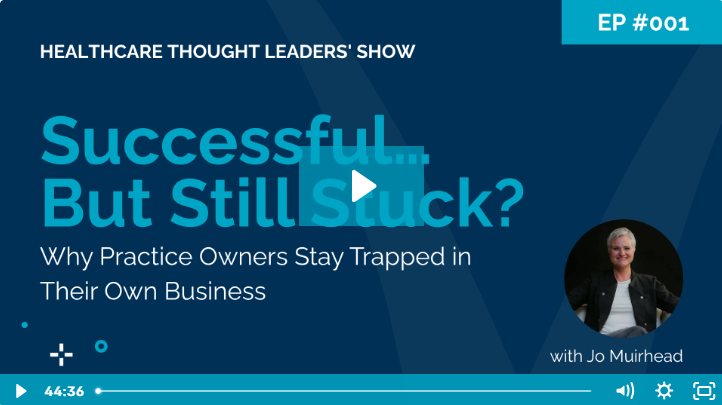
Recently I had the privilege of being interviewed by Megan Walker for the very first episode of her new HealthCare Thought Leaders Show.
The conversation covered everything from profitability and leadership to thought leadership and the future of private practice, but there was one theme that kept resurfacing throughout the discussion:
Many successful health professionals are still trapped inside the businesses they’ve built.
You can listen to the full interview here:
As Megan and I talked, I realised something.
One of the biggest mistakes I made as a business owner wasn’t financial.
It wasn’t marketing.
It wasn’t hiring.
It was continuing to think like the clinician who started the business long after the business needed a leader.
The Behaviours That Built the Business
Like many health professionals, I started my business by doing what I knew how to do.
I worked hard.
I looked after clients.
I solved problems.
I said yes to opportunities.
I built relationships.
I became known for doing good work.
And those behaviours worked.
The business grew.
The team grew.
The reputation grew.
The referrals grew.
The problem was that I assumed the behaviours that helped me build the business would also help me grow it.
They didn’t.
When Being Helpful Becomes a Problem
For years I believed leadership meant being available.
I thought leadership meant solving problems.
I thought leadership meant being the person everyone could rely on.
I thought leadership meant carrying responsibility.
What I eventually realised was that I wasn’t leading.
I was bottlenecking.
Every decision came through me.
Every challenge came through me.
Every difficult conversation came through me.
Every complaint came through me.
I wasn’t creating capacity in the business.
I was creating dependence.
The irony is that many health professionals wear this as a badge of honour.
We tell ourselves that being indispensable is a sign of value.
It’s not.
It’s a sign of risk.
Because if everything depends on one person, eventually that person becomes the weakest point in the system.
The Lesson Cancer Forced Me to Learn
In 2020 I was diagnosed with bilateral breast cancer.
Suddenly I was confronted with a question many business owners avoid:
What happens if I can’t show up?
Not because I don’t want to.
Not because I need a holiday.
Because I physically can’t.
It was one of the most confronting leadership lessons I’ve ever experienced.
The business needed to function without me.
And that required a very different version of leadership than the one I had been practising.
Your Clients Need a Clinician.
Your Business Needs a Leader.
This is one of the most important distinctions I have learned.
Your clients need your clinical expertise.
Your business needs your leadership.
They are not the same thing.
Health professionals spend years learning how to become clinicians.
Very few of us spend the same amount of time learning how to become leaders.
Yet leadership is exactly what becomes necessary when a practice grows.
At some point the question is no longer:
“How do I become a better clinician?”
The question becomes:
“How do I become a better leader of clinicians?”
That’s a very different challenge.
Success and Freedom Are Not the Same Thing
One of the reasons I enjoyed this conversation with Megan so much is that we talked openly about something many people avoid.
Success does not automatically create freedom.
You can have:
- A full caseload
- A growing team
- Strong revenue
- An excellent reputation
And still feel trapped.
Because if everything depends on you, you haven’t built freedom.
You’ve built dependency.
The goal of business ownership isn’t to become indispensable.
The goal is to create something that works because of your leadership, not because of your constant presence.
If This Sounds Familiar
If you’ve ever found yourself wondering why your business still feels heavy despite all the work you’ve put into it, you’re not alone.
Many of the health professionals I speak with are not struggling because they lack capability.
They’re struggling because the business has evolved and their leadership hasn’t had the opportunity to evolve alongside it.
That’s fixable.
But it starts with recognising that being a great clinician and being a great business owner are two different jobs.
You can listen to my full conversation with Megan Walker here: https://www.meganwalker.com/thought-leaders-show-001
I’d love to know what resonated most with you.
And if this article felt a little too familiar, perhaps the question worth asking is this:
If you stepped away from your business for four weeks, what would happen?
Your answer may tell you exactly where your next stage of growth needs to occur.