
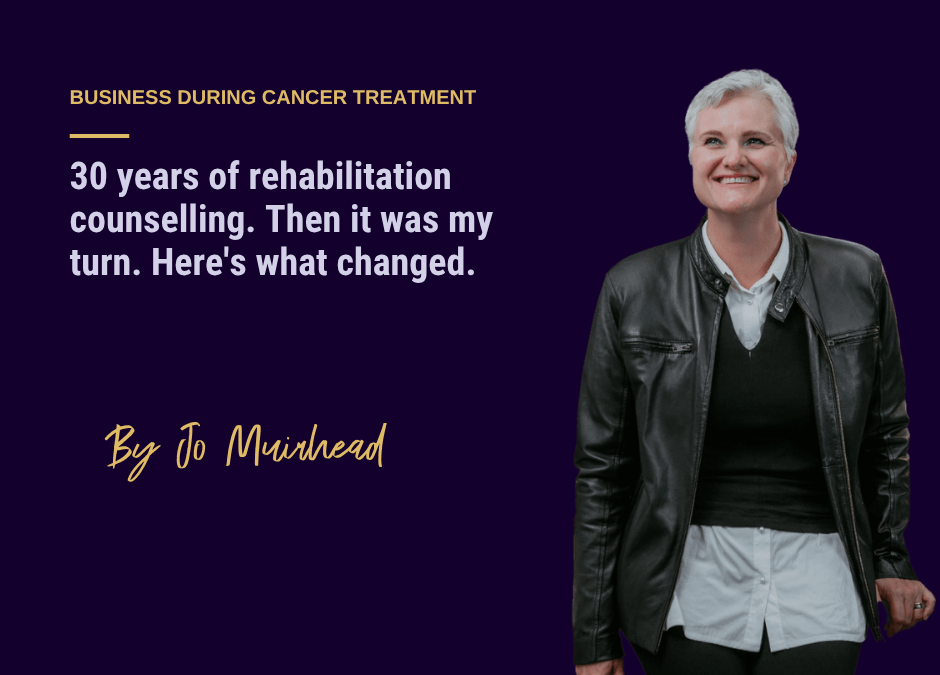
A few people have reached out to me lately, asking the same question in different ways.
How do I keep my practice going while I go through treatment?
(If you only have energy for the short version: I’ve put the key questions from this post into a one-page checklist you can download here → https://jomuirhead.com/wp-content/uploads/Flyer-A-Few-Questions-Before-You-Decide-Anything.pdf.)
Some are allied health business owners. Some are therapists, psychologists, coaches. All of them are facing a cancer diagnosis and trying to work out what happens to the business they’ve built while their body is otherwise occupied.
I want to help. But I also want to be honest about the limits of what I can offer here.
Cancer treatment is different for every person and every cancer type. What I’m about to share is what happened in my own business, over roughly two years, while I had bilateral breast cancer. It is not a formula. Some of it may not fit your situation at all. If you want to work through your specific circumstances, that’s a conversation, not a blog post — and I’ll point you there at the end.
But I have noticed some common themes in what people are asking me, and I think there’s real value in hearing what actually happened for me, rather than what the textbooks say should happen.
There isn’t time to plan
Nobody plans for a cancer diagnosis. You don’t get a run-up.
I think of it as being put on a bus that’s already moving, and moving fast. You’re in survival. You’re trying to do the best thing by your clients, your team, your family, and yourself, often all in the same hour. There isn’t a lot of room, in that moment, for the kind of considered decision-making any of us would want to bring to our business.
That matters, because a lot of the advice I’m about to give you sounds obvious in hindsight. It wasn’t obvious to me at the time. Keep that in mind — for yourself, and for the people around you going through this.
Working, or not working, are both legitimate choices
In my previous career working with people on income protection claims, I saw a pattern: a lot of self-employed people, once they received a serious diagnosis, simply closed their business. It was too much, for them and for the people around them.
I didn’t want that for me. Working kept me connected to something outside my illness and my treatment. But I want to be clear — that was my choice, not the right answer. About two years into my own treatment, one of my contractors received a breast cancer diagnosis too. She chose to stop completely. That was the right decision for her.
There isn’t a correct answer here. There’s your answer.
The money question nobody tells you about
I had income protection insurance, and it did exactly what it was meant to do — it covered my personal income when I couldn’t earn my usual wage. What it didn’t do was protect my business. Over roughly two years, my revenue dropped by more than two-thirds.
Those are two different things. Your personal income and your business revenue are not the same risk, and most people only insure for one of them.
Here’s what actually happened. I had a team, and my instinct was to hand my caseload over to them. My expectation was that this would simply redistribute the work, and the billing would carry on much the same. That is not what happened. Anyone who has handed files to already-busy people knows that extra work doesn’t always become extra output. It may have been smarter to bring in someone dedicated to my caseload specifically — though that comes with its own cost, and there would still have been a dip, just a smaller and more predictable one. I’d offer you both as genuine options, not one correct path. Most of us don’t have a contingency fund sitting aside for a locum, and a cancer diagnosis doesn’t give you time to build one.
I didn’t reduce my fees. Charging full price while I couldn’t reliably meet the standard my clients deserved didn’t sit right with me. What I want you to hear, though, is this: the risk during this time wasn’t that I’d underperform. It was that I’d overfunction. I had no trouble showing up and doing good work in the room with a client. What fell behind was everything around it — notes, admin, the paperwork that keeps a practice running. That’s where your energy actually needs protecting, and it’s rarely where people expect to need it.
And here’s the piece that was genuinely hard: partway through treatment, my accountant resigned. In Australia, a company can’t simply go without one — ASIC requires it — so I had no choice but to find and onboard someone new, at exactly the time I had the least capacity to do it. It was an enormous emotional and cognitive load on top of everything else. I was fortunate — the new practice treated me with real patience and grace. But I wouldn’t count on being fortunate. The lesson isn’t “get a trusted advisor.” It’s get the right one in place before a crisis, because replacing one during it costs more than you’ll have to spare.
That trusted advisor doesn’t have to be a formal title. It might be your bookkeeper or accountant. It might be a fractional COO, a mentor, or a coach — someone who can think alongside you without your emotion and without your depleted energy sitting in the room too. When the dollars start to drop, it is very easy to tip into scarcity, into fight-or-flight, on top of whatever fight-or-flight your health is already asking of you. Having someone steady beside you matters more than having all the answers yourself.
Telling your clients
I told my rehabilitation counselling clients I was stepping away from that caseload entirely. The deciding factor wasn’t whether I could still do the clinical work. It was the accountability that caseload carried to funders — more reporting, to more people, with more scrutiny than I thought was fair to ask of myself during treatment. If any part of your work carries obligations to someone other than the person in front of you, that’s worth looking at first. It’s often the first thing that becomes unmanageable.
With my coaching clients, I kept two — people I was in the middle of meaningful work with, and judged I had the capacity to continue with. That held until my second round of chemotherapy made it clear it no longer did. One chose to pause until I was well again. The other was glad to be referred to a colleague.
What I actually said, to all of them, was close to this:
“I have been diagnosed with bilateral breast cancer, and this is going to be a really difficult time for me. I want to ensure you continue to receive the services I know you need, and I’m concerned I won’t be as available or reliable during this period. I’d like to refer you to a colleague who I think would be a great fit, and use the next couple of weeks to make sure the handover goes well.”
Not one client pushed back. All of them were gracious.
I think I know why. I came from a place of treating them the way I would want to be treated — transparent about what was happening, and offering choices I genuinely believed were good ones, even if not the ones they’d have picked. And because I was visibly, undeniably unwell, there was nothing left to negotiate. Illness made the boundary easier to hold, not harder. If you’re dreading this conversation, that’s worth sitting with.
The grief about ending those client relationships didn’t arrive for me until years later. There wasn’t room for it on the bus. I’ll leave that there for now — it’s a bigger conversation than this post.
Keep it simple everywhere else
A few smaller things that mattered: streamline everything so a to-do pile doesn’t become a doom pile. See clients for fifty minutes, not sixty, and use the ten minutes you’ve bought back for notes. If someone asks for something you can’t deliver on — a report, a piece of work — tell them honestly what your current timeframe looks like. You’ll be surprised how many people didn’t need it as urgently as they thought. And if you can, let someone else stand between you and your inbox, your phone, your social media — which only works if you’ve already worked out what they have authority to handle, and what has to come to you.
Where this leaves you
Everything here is what worked, or didn’t, in my business. It isn’t a plan for yours. Your cancer type, your treatment, your business structure, your team, your clients — all of it will shape what the right decisions look like for you, and I can’t give you that specificity in a blog post.
(If you only have energy for the short version: I’ve put the key questions from this post into a one-page checklist you can download here → https://jomuirhead.com/wp-content/uploads/Flyer-A-Few-Questions-Before-You-Decide-Anything.pdf.)
If you want to work through what this actually looks like in your practice — the money decisions, the client conversations, what to keep and what to let go of — that’s what a coaching session is for. I’d be glad to sit with you in it.